It feels like quitting season lately.
Summer is always slow, and plenty of founders I watched quit their fancy jobs last October to build a startup are starting to wonder about quitting again.
But this time, many walk away with 9 months of anxiety and a more negative bank account.
I'm being pretty sarcastic and mean here, but that's because I hate myself for having had this same thought 3 years ago, when I left Backed VC to start my first venture.
PG is right about this in his new essay, "How to Earn a Billion Dollars" (credit to Jenny for sharing!): when you're young, you don't have enough experience to know what other people need, so you should build something you yourself want. As he puts it, "your own needs are uniquely valuable, because your needs predict future demand." The bet is that young people are demand's leading edge — today's weird little habit becomes everyone's default a decade later.
I followed this principle fervently for the first 9 months of my startup journey, and boy, I tell you what — it was a disaster.
Don't get me wrong — I think PG is generally right on this. But for a specific type of founder, like me, following it is the fastest way to catch false signals and lose confidence. His whole argument rests on one premise: that your own needs are a reliable signal. Mine weren't.
The reason is, I don't actually know enough about my own desires.
I don't know what I need. It's been suppressed for so long that I spent 9 months digging every little signal out of myself — and none of them turned out to be a need that wasn't already met. I was just poor, and I wasn't even aware that there were so many options on the market that would have solved it for me, if I'd just paid for one. So I was constantly over-estimating market demand and amplifying positive signals when I should have been ignoring them, given how fast the market was growing.
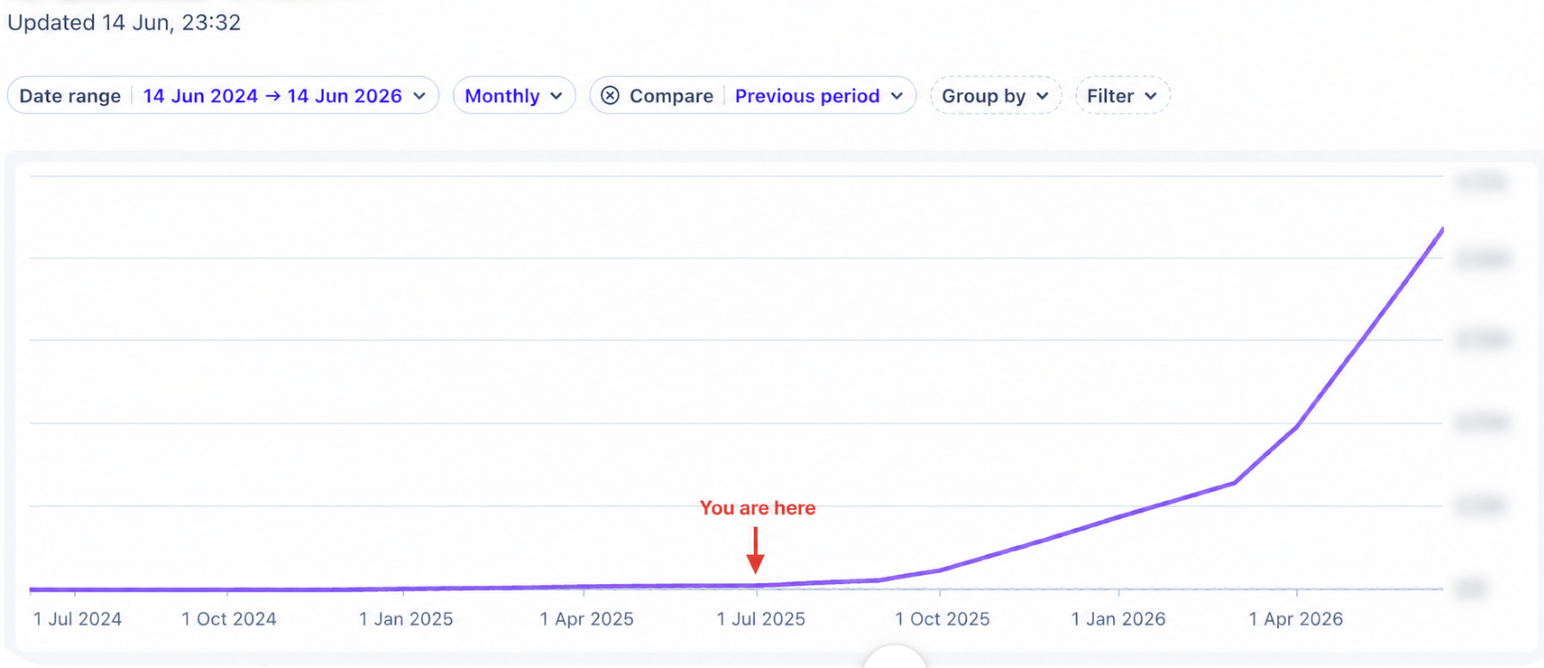
Over the years at Backed and running my own startup, I've been fascinated by founders who have a squiggly, flat growth curve for years and then suddenly take off — why does this even happen?
It wasn't until recently, when I started spending time on Peony — which sits in a domain that, frankly, isn't popular among young founders, because it simply isn't something they need often — that I began to understand why late-bloomer founders exist.
Most founders who go through this share a strikingly similar path: they start something, struggle for 5–7 years, then something finally clicks and things go exponential.
That's the exact same story for Peony (not to say we're there yet), a cloud file-operations startup that had little traction for years until we made the right pivot — and funny enough, the winning demand was not our own.
The reason this happens is that founders like me, who grew up in extremely poor environments, learn not to ask for things in life. It just makes us sad and miserable to keep hearing no, over and over, while our environments keep telling us our desires aren't justified, that there are other things we should be focusing on.
But you know what? Founders like me also tend to read a room extremely well, because we were trained to — catch the shift before mom heats up or a stranger yells. So we get very, very good at reading other people's needs.
For founders like us, observing and building on our own needs tends to be a waste of time. Roughly speaking, the degree of poverty you grew up in, multiplied by the share of "no"s you got whenever you asked "can I have this?", is a decent numerical proxy for how unlikely you are to build a good startup out of your own demands.
Similarly, if you happen to love having friends, you'll struggle to capture useful demand while you're young, because most of your friends are probably young too — they're not yet in big B2B settings, or their roles are so junior that they might be the end user but not the person who actually signs off on the purchase.
So how does this weird loop break — where if I want to solve my own problem, it turns out solutions already exist, and if I want to solve my friends' problems, they're not the ones who can pay?
Well, mine broke simply because I got older. I started making older friends, and I figured out that only hanging out with people my own age was never going to help. The pivotal moments for both Gingercontrol and Peony came once we started attending events where people were about twice my age.
Yes, it's harder to build trust when you don't look mature enough to handle high-stakes business — but tbh that's a smaller blocker than not knowing what people actually need.
So if you find yourself in a similar situation to mine, just pause for a second and ask whether you might be wearing the same shoes — or maybe your room is just full of happy people who never complain :)
There are two patterns that keep showing up in late-bloomer founders: first, they come from a background where their desires were likely suppressed for a long time; second, they're either people-pleasers or very good at reading rooms.
You don't have to give up just because you haven't found demand you can satisfy yet — maybe you're just looking in the wrong places for it.